In astronomy, the magnitude of a star is a number that is used to describe its brightness. The brighter a star is, the lower its magnitude will be. For example, the bright star Sirius has a magnitude of -1.46, while the faintest stars that can be seen with the naked eye have a magnitude of about 6. The magnitude of a star can also be used to describe its absolute brightness. The absolute magnitude of a star is the magnitude it would have if it were viewed from a distance of 10 parsecs (32.6 light years). This is useful for comparing the brightness of stars that are at different distances from us. The limiting magnitude is the faintest star that can be seen with a given telescope or other instrument. This is usually given for a particular aperture size and observing conditions. For example, the limiting magnitude for the Hubble Space Telescope is about 30, while for small amateur telescopes it is around 11.
Astronomers use a scale of stellar magnitude to determine the brightness of a star or object in the sky. There are no stars brighter than magnitude -26.7, but there are no stars brighter than magnitude -3. The faintest star you can see with your regular eye is at magnitude 6.0 in most cases. The apparent size and brightness of celestial objects are determined by the telescope’s aperture, the eyepieces and accessories you use, and ambient light. RASA telescopes do not have a limit-sized stellar magnification feature. Use websites, planetarium software, or mobile apps to learn more about a specific comet’s size.
What Is The Meaning Of Stellar Magnitude?
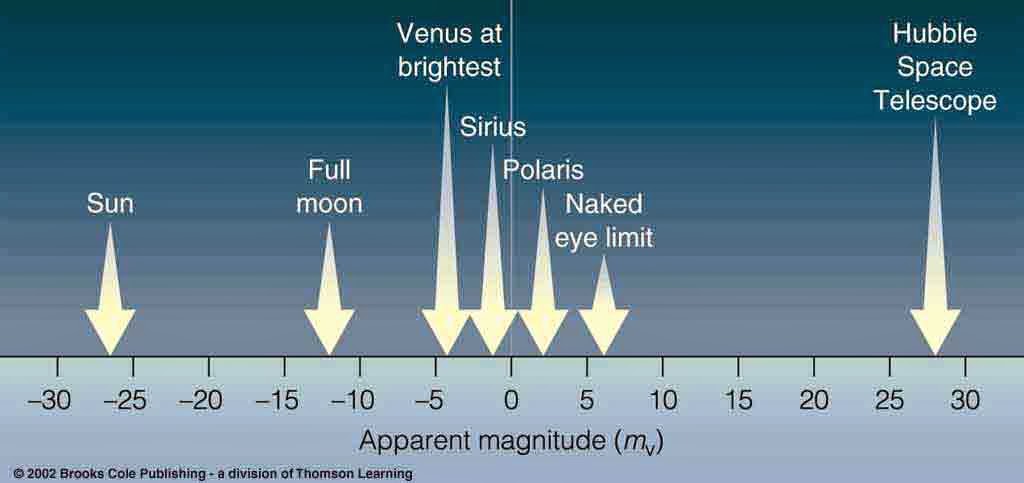
A star’s or other celestial body’s magnitude is determined by its brightness. A brighter object is less represented as a magnitude. Stars were classified into six different magnitude classes in the ancient past, with the most powerful being the most beautiful.
Magnitude is the unit of measurement for a specific portion of the electromagnetic spectrum that corresponds to a star’s brightness. Hipparchus (c. 166-125 BC), a Greek astronomer, discovered the magnitudes in the second century BC. The magnitude of the star is expressed in a number that represents its intensity. It is difficult to see stars in the near future unless one is wearing an optical aid, and it is best to use sharp eyes when possible. When viewed with the most powerful telescope on the planet, the faintest object that appears has a magnitude of about 30. However, absolute magnitude reveals a truth: the sun has a magnitude of +4.8 while Sirius has a magnitude of 1.4. The Sun’s apparent brightness is significantly lower than that of the faintest object ever seen (in the Hubble Space Telescope) by humans, and it is more than 56 magnitudes brighter.
Astronomers frequently disagree on how to convert measurements in one system to another due to the vast number of other types of brightness measurement systems in use. A star’s magnitude is its energy output. A magnitude of one represents a factor of 2.512 in terms of brightness. B–V gives a good estimate of the temperature of a large number of stars. The value V–R can be used to determine the radius of a star.
The magnitude system has been revised several times since it was first conceived, most recently in 1983. Today, the magnitude range is 12 to 10.51, from 0.4 1.4 to 1.4. Each level has 100 sublevels, each with a brightness increase of 5.5 times. A star of magnitude 5.5 has a light intensity of about 100,000 times that of a star of magnitude 3. The sky has a limited number of stars that are particularly bright in the lower magnitude. These stars’ close proximity to Earth allows them to be larger and brighter than other stars in our vicinity. The brighter stars appear to be less visible as they move up the magnitude scale due to their distance from us. Astronomers rely on the magnitude system to help them identify and locate stars because it allows them to look at them in greater detail. This component of the night sky aids us in orienting ourselves within the universe.
Which Stellar Magnitude Represents The Brightest Star?
Stars with a 1st magnitude are the most easily visible in the sky.
What Is The Stellar Magnitude Of A Telescope?
Under zero light pollution conditions, each telescope and binocular comes with a “Limiting Stellar Magnitude” specification, which indicates the magnitude of the faintest object seen through the lens with that optic (see image below).
What Is The Magnitude Of A Star Called?
It refers to the brightness of a star or other object visible from Earth at an angle. If the object’s intrinsic luminosity, distance from the Earth, and extinction of light caused by interstellar dust along the line of sight to the observer are all taken into account, its apparent magnitude is determined by its intrinsic luminosity, distance from Earth, and extinction of light caused by interstellar dust.
What Is Limiting Stellar Magnitude On A Telescope?
A telescope’s aperture size and exposure time all have an impact on its effectiveness. The scope is usually smaller if it is exposed for a longer period of time. The maximum magnification of the human eye is approximately 6.5 magnitude in response to dark adaptation and the most optimal observing conditions.
If the eye is exposed to the dark, its pupil diameter is approximately 7 mm. A telescope is used to view a much larger area than simply a 7mm pupil of your eye. Because a telescope can see far more stars, it is easier to see very fainter stars with it. You can calculate the magnitude difference between two stars by using the Magnitude Difference scale. The ratio of their brightness can be calculated by using the logarithm. Vega serves as a reference point for the scale, which means that each star’s magnitude is based on its brightness relative to Vega. The magnification limit of a scope can only be determined by the diameter of the objective.
To calculate the magnitude of the smallest object visible in the scope, we simply add Lmag to Gmag. You don’t have to convert a point to another point to convert it to another point. When the magnification is higher, the stars begin to spread and dim. You can use a logarithm to estimate the magnitude limit of a scope in seconds, thanks to its tame and forgiving nature.
What Do You Mean By The Limiting Magnitude Of A Detector?
The image’s spatial noise in the background limits the number of astronomical objects it can detect. A limit magnitude is the brightness of the object that can be detected at a distance of less than a mile.
What Is My Limiting Magnitude?
Longer exposures are generally more limiting, with the less exposure time the weaker the limit. The human eye’s limit to its range of vision is only 6.5 in the best observing conditions after dark adaptation and with the best conditions.
What Is Naked Eye Limiting Magnitude?
When a telescope is held at an observer’s eye, the naked-eye limit is the magnitude of a star that is faint. Under certain conditions, the sky can be viewed. The magnitude of the limiting is strongly dependent on the magnitude of the limiting. The observer’s ability to perceive the sky and to observe clearly are measured by his or her acuity of vision and sky transparency.
What Does Magnitude Tell Us About A Star?
The magnitude of a star is a measure of its brightness as seen by an observer on Earth. The brighter the star, the lower the magnitude. The magnitude scale is logarithmic, so a star with a magnitude of 1 is 100 times brighter than a star with a magnitude of 6.
Using the magnitude of a star as a measuring device can provide a good sense of its brightness. The absolute magnitude of a star is defined as its intrinsic brightness, regardless of what other elements are emitting into its path.
The table below depicts the absolute magnitude of some of the most brilliant stars in the universe. A magnitude of 1 is assigned to the brightest stars, while a magnitude of -6 is assigned to the faintest stars.
The distance between stars is also shown in the table. When the distance between a star and the Earth is greater than or equal to the Earth’s surface, the light from the star appears brighter.
The table depicts the position of the most brilliant stars, which are located far away from Earth. Star Sirius, the brightest in the Universe, can be found approximately 33 light years away.
The table also reveals that the faintest stars in our sky are only a few hundred light years away. Proxima Centauri, a dim star located approximately 43 light years away from Earth, is an example of this.
It is simple to determine the intrinsic brightness of a star by looking at its absolute magnitude. The table depicts stars that are bright but far away from us.
The Brightness Of Stars
The brightness of a star is determined by measuring it on a logarithmic scale, with the brightest stars at the lower end and the faintest stars at the higher end. In the magnitude scale, there are six classes: first magnitude stars, second magnitude stars, third magnitude stars, fourth magnitude stars, and fifth magnitude stars. It is brighter if the magnitude is greater than that of the star. A magnitude of 1 will give you roughly twice the brightness of a magnitude of 6. The difference of magnitudes causes a brightness factor to be ten times larger than its nominal value. A 1st-magnitude star is 100 times brighter than a 6th-magnitude star. A 6th-magnitude star, on the other hand, is 100 times dimmer than a 1st-magnitude star. The magnitude of a star is meaningless unless it is glowing. A star can be brighter or dimmer depending on how far away it is from Earth.
What Is Limiting Magnitude
The limiting magnitude is the faintest magnitude an object can reach and still be seen by the human eye. It is affected by many factors, such as the observer’s eyesight, the amount of light pollution, and the weather conditions.
The Brightness Of Stars
Because the magnitude scale is logarithmic, every two magnitudes (or 5x increases in brightness) leads to a tenfold increase (or 100x increases in brightness). As a result, the magnitude 6 object, for example, has a magnification of 100x while the magnitude 5 object has a magnification of 5x.
Similarly, if you have an 8-inch diameter telescope and an object with a magnitude 6.5 aperture, you can see a object with that telescope, but you can’t see an object with a magnitude 8.5 aperture.
What Is Limiting Magnitude Telescope
The limiting magnitude of a telescope is the faintest star that it can detect. This is determined by the telescope’s light gathering power and the background sky brightness. The larger the telescope’s aperture, the greater its light gathering power and the fainter the stars it can detect. The background sky brightness is affected by light pollution, which makes it more difficult to see faint stars.
Limiting Magnitude Formula
The formula for the limiting magnitude,n’t, visible in a telescope of aperture D inches, is ni 8–105logD. This corresponds to a limiting magnitude of approximately 6:.
As a general rule, I should use the following limit magnitude for my telescope: General Observation and Astronomy – Cloudy Nights. It was posted at 0 06:46 PM on 09 February 2020. Is it possible that I used the formula at all, but I’m not sure where I found it? I’m currently using LILIMMag =. To calculate the NELM, add the dimensions (angle of the brace/pupil) and the power per inch (power per inch). All values in millimeters are represented by the simple formula NELM, which is 5*Log(Aperture). My telescope can achieve a high magnification of *19th mag on stars and *18.5 on galaxies when in a dark spot with good visibility.
Could someone check that you see somewhat deeper than you expected? My monocular telescopic magnitude limit is usually far exceeding what it should be. I’m not sure what’s causing it, but I assume the scope has something to do with the small exit pupil. It does not have a significant impact on NELM unless the sky is dark. When a very dark sky is reduced by a single MPSAS, the eye responds by approximately a 0.5 magnitude increase. As the exit pupil narrows, the diffraction of point sources becomes longer, increasing contrast and necessitating the setting of a diffraction limit. Duplication is beginning to transform even the dimmest stars into longer objects in a very dark sky, at roughly the same time that one runs out of magnification.
The naive formula corrects NLEM by ignoring magnification and binocular vision, while ignoring the aperture equation. My experiments discovered that this is very nearly true for binoculars with an exit pupil similar to mine. The magnification of 1X is far too low for an instrument with a classic 7-mm aperture. My native magnification for my 5mm aperture is much closer to 10X than my magnification for my eyes, which is much closer to the normal magnification of my eyes. Bright stars should appear like pretty generous Airy Discs at 60x/inch, whereas dim ones should appear like dots. As a result, a half-mm exit pupil should pull in the dimmest stars. How does the naked eye aperture of a camera sensor be expressed?
Is it 1 and the term drops? The article was published on February 10, 2020. Do you ever take your dob to a star party? My bucket list includes a list of 25 things that I want to do. I have a bucket list that includes 25 bucket list items. One of the major variables in any formula is experience; I believe that is nearly impossible to factor into one. The ability to see faint stars has been improved by using a telescope.
The eye does not need to be fully integrated into the world in order to function properly; it is very short, perhaps 1/10th of a second. Because the NELM is not an average of surface brightness and SQM, it is not used as a measurement of sky brightness. In addition to the standard entrance pupil, magnification beyond that allows the surface to be brighter. TLM can be affected by eyepiece magnification (and a slew of other terms found in the eyepiece calc webpages that I don’t look up on the day of viewing magnification). TLM is equal to slope * log (diameter mm) and intercept. It makes more sense to use a de-rating factor ranging from 50 to 60x/inch if I were going to adjust for mag. Experience is one of the most significant variables that is nearly impossible to factor into a formula.
An analogous comparison would be to a suburban sky condition with a significant loss of contrast, in which contrast is an important factor. In the dark, I’ve seen Pluto at 14.3 mag while looking at 110ED from the ground. If the magnification is 14.2 or 14.5 mag, I’m not sure I’d be able to fit it in even at night. A star that is magnitude brighter is more likely to be detected because it emits 43 photons per second over the same period, which means a persistent signal can be produced. I have to wait for a few minutes to get a few confirmed hits in the same position and screen out noise to ensure that a star isn’t immediately or almost always observed in this manner. Even if everything else remains constant, the dimmer objects will become dimmer as you get older. You’ll have to deal with too many variables if you try to use calculations, which is tedious and frustrating at times. If you describe something as diffraction off some pointlike features on your own lens, it would sound like something out of a Jules Das novel. Cataract surgery is one option, but it is also possible that cataracts are to blame.
Stellar Magnitude
Stellar magnitude is a measure of a star’s brightness as seen by an observer on Earth. The brighter the star, the lower the stellar magnitude. The stellar magnitude scale is logarithmic, with each increase of 1 magnitude corresponding to a decrease in brightness by a factor of 2.5.
In fact, star magnitudes are recorded backward as a result of an ancient fluke that appeared to be a good idea at the time. Ptolemy copied this system in his own star list around 140 B.C. The first change was necessitated by Galileo. Today’s binoculars have a magnification of about 50 millimeters, and they will display stars of about 9th magnitude. Previously, scientists had discovered that a 1st-magnitude star can shine at 100 times the light of a 6th-magnitude star. A brightness ratio of 100 to 1 indicates a difference of five magnitudes. A brightness difference of one magnitude corresponds to a brightness difference of exactly the fifth root of 100, or approximately 2.5%12. In the nineteenth century, astronomers used photography to photograph stars.
On film, some stars with similar brightness to the eye displayed different brightness levels. The classification of magnification systems for different wavelengths was difficult to specify. A standard photoelectric photometer displays data that allows it to determine precise magnitudes. The magnitude of an object’s total energy emission is commonly regarded as the most accurate measure of its real energy in Earth’s atmosphere. Its absolute magnitude is simply the amount of light it produces when placed at a distance of 10 parsecs (30.6 light-years). The absolute magnitude of a star is determined by its ability to generate a luminosity of more than 10 times the density of light in the Earth. This distance, it appears as though the Sun shines at an unremarkable visual magnitude of 4.85; Rigel shines at a stunning –8, nearly as bright as the quarter Moon. Proxima Centauri, the nearest star to our solar system, is thought to have a magnitude of 15.6.
A star’s magnitude can range from 1 (the lightest) to 6 (the brightest). Because the magnitude scale is logarithmic, the difference of 1 magnitude corresponds to a tenfold increase in brightness. In terms of magnitude, Sirius, the most distant star, has a magnitude of 0.7, while Proxima Centauri, the brightest star, has a magnitude of 0.4.
The magnitude classes are as follows: 1, 2, 3, 4, 5, and 6.
The first magnitude class is distinguished by the presence of some of the most brilliant stars. These stars have a magnitude of 1.0 or higher and are bright enough to be seen from the Earth.
The second magnitude class contains slightly brighter stars than the first magnitude class. There are numerous stars in the constellation of Cycladus with a magnitude of 1.5 to 1.9.
Stars with the third magnitude class have a brighter color than those with the second magnitude class. There are three types of stars with magnitudes ranging from 2.0 to 2.4.
The fourth magnitude class is home to stars that are slightly brighter than the third magnitude class. A magnitude of 2.5 to 2.9 can be found in these stars.
The fifth magnitude class contains stars that are roughly the same brightness as the fourth magnitude class. These stars have a magnitude ranging from 3.0 to 3.5.
The sixth magnitude class contains stars that are significantly brighter than the fifth magnitude class. Stars with a magnitude of 3.5 are brighter and brighter than these.