The stellar spectral classification is a system used by astronomers to classify stars based on their spectral characteristics. The spectral class of a star is determined by its temperature, which is measured by its color index. The stellar spectral classification system has three main classes: O, B, and A. Each of these classes is further divided into subclasses. The O class is the hottest and is subdivided into subclasses O0, O9, and so on. The B class is slightly cooler and is subdivided into subclasses B0, B9, and so on. The A class is the coolest and is subdivided into subclasses A0, A9, and so on.
Astronomers in over 40 countries used various methods to obtain larger and larger collections of stellar observations. Photographs were taken with photographic plates and left in their original negative form. The Harvard University Observatory began to develop methods for classifying stars over time. The Henry Draper Catalog of Stellar Spectra, which he developed, is still one of the most important sources of information on stars. Cannon created the temperature sequence that has since been used as the primary method of classifying stars. According to Hertzsprung, stars have a nice relationship with absolute magnitude (or luminosity) and color (or temperature). Dwarfs and giants were two types of stars: giants with weak, narrow lines and dwarfs with strong, broad lines.
Harvard already owned and classified tens of thousands of stars. Hertzsprung and other astronomers may now be able to identify dwarfs or giants using their spectral classifications. In the MK system, Harvard’s spectral classes were used as the primary reference. Each star’s luminosity class, on the other hand, is added to its entry in the MK system.
Why are spectral lines used for classifying stars? In these photographs, the composition of a star is shown.
What is the difference between a star’s spectral class and its mass? Its spectrum has a set of lines.
A classification of stars based on their spectrum and luminosity in astronomy.
Beagle (astronomy) is one of the sciences mentioned in this text. It is a common practice for black-and-white photography to obtain a star’s spectrum with a slit spectrograph; however, in most cases, absorption lines are superimposed on a continuous background.
What Does Spectral Classification Do?
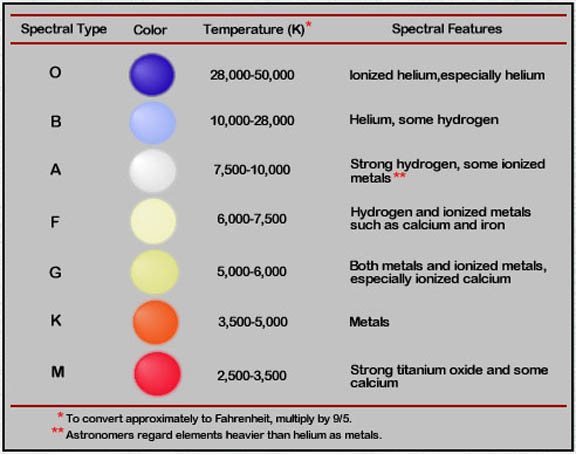
The spectral types and subclasses represent the temperature sequence from hotter (O stars) to cooler (M stars), and from hotter (subclass 0) to cooler (subclass 9). Temperature is required to determine the star’s color and surface brightness.
What Does The Stellar Spectra Tell Us?
It is possible to determine not only the element’s temperature and density, but also its surface area and composition, using spectral lines. In addition to revealing the magnetic field of the star, we can use the spectral line to tell us about the color of the star. The speed of a material can be determined by the width of its line. This will teach us about the winds that blow through stars.
A spectrograph is a device that measures the amount of light emitted by a star at optical wavelengths. The temperature and wavelength of a star are measured using a simple mathematical formula. We can see light from the outside of a star, which can tell us a lot about the state of its outer atmosphere, because red and blue stars are cool (temperatures below 4500 K), and blue or blueish white stars are hot (temperatures above 9000 K). A star’s inner regions absorb light and carry it outward to the surface. This is what makes the photosphere of a star’s gaseous atmosphere. Photons may be absorbed by atoms or ions if they fly through the outer layers of the stellar atmosphere. In four stars’ spectrum, absorption lines are visible from elements in their outer atmospheres.
atoms absorb light in a series of wavelengths by absorbing light at these absorption lines. Astronomers used the strength of various absorption lines to classify stellar spectra. In the first excited state, atoms absorb a photon, and then jump to a higher excited state, resulting in these reactions. Because of the differences in temperature, the strength of the lines changes.
The temperature variations of stars are determined by their surface gravity, according to scientists. When a star is much larger, its internal heat rises, resulting in its expansion. As a star cools down, its surface gravity rises. The three major groups of stars are I, II, and III, respectively. Metals with strong or numerous metallic lines and weak or no HI lines are considered strong or numerous metallic lines. Some of the stars are hotter than 5000 degrees Celsius, such as the Sun and the majority of other stars in the I class. Many stars in this class have metallic lines, including those with a temperature of less than 5000 Kelvin. Stars in the III class have molecular lines in prominent bands. Stars’ surface temperatures and surface gravity are related in some ways, but their spectral properties differ. Because of their greater temperature range, stars in the I and II classes have more spectral features than stars in the III class. The III class has features that are similar to the colors of the planets, in addition to being more closely related to the Earth’s temperature.
The Colors In An Atomic Spectra
electrons are excited when they are exposed to an element, resulting in lines in an atomic spectrum. Electrons, with their tiny radius and high mobility, can travel from one state to another in a matter of seconds. When an electron jumps from one state to another, it emits light energy. Higher energy levels (in the atom) absorb more electrons, whereas lower energy levels empty. When an electron moves from one state to another, it can lose some energy. As a result, the energy lines in an atomic spectrum are higher (the electron has more energy than the molecular spectrum), while the energy lines in a molecular spectrum are lower (the electron has less energy). The colors in an atomic spectrum differ from one another due to the separation of electron energy levels. An electron’s energy level changes when it moves from one to another, causing it to lose a certain amount of energy. The number of protons in an atom determines the color of an atom’s line. Nitrogen has seven protons in addition to being green, which means that its line is green.
Spectral Class Of Stars
The spectral class of a star is a measure of its surface temperature and is represented by a letter; the hotter the star, the earlier the letter in the spectral class. The spectral class of our Sun is G.
The Hertzsprung-Russell Diagram plots star color, temperature, luminosity, spectral type, and evolutionary stage in a plot format. Stars are classified by their spectra (the elements they absorb) and temperature. Each star type is classified according to its position on the scale, ranging from 0 to 9. Red giant stars are relatively old stars whose diameter is much larger than it was originally and who have lost their heat over time. neutron stars are extremely small, super-dense stars that are mostly made up of tightly packed neutrons. Pulsars are neutron stars that spin rapidly and produce energy in pulses. A two-star system holds approximately half of all stars in our galaxy. Polaris, our northern polar bear, is located in a binary system composed of four stars. Variables named after stars like Mira were discovered in 1596 and named after the star.
Reddest and coolest stars with redshifts, also known as M-type stars, are typical of this type of star. Their surface temperatures range from 2,400 to 3,700 degrees Celsius, making them the most common type of star in the universe. In addition to the M type of star, a wide range of other types of stars can be found in our solar system. The presence of M-type stars is important in the universe. Despite the fact that they are the primary producers of elements heavier than hydrogen and helium, they are essential for life. The most common type of star in the solar system is a M-type star, which is a critical component of our cosmic neighborhood.
How Are Stars Classified
In general, there are six classes, which are referred to as ‘O,’ ‘B,’ ‘A,’ ‘F,’ ‘G,’ and ‘K.’ Stars in ‘O’ class are the most massive and hottest, with temperatures reaching 30,000 C In comparison to stars in the ‘A,’ stars in the ‘M,’ ‘D,’ and ‘E’ classes are the smallest and coolest at temperatures below 3,000 C. Stars are not always the same color as one another, which is visible as you approach the sky.
Stellar Spectra
A stellar spectrum is the distribution of electromagnetic radiation emitted by a star, as a function of wavelength or frequency. The stellar spectrum can be used to identify the chemical composition of a star, as well as its surface temperature.
Researchers use a variety of techniques, including spectral analysis, photometry, and spectroscopies, to determine the composition of a star. Using sedat analysis, it is possible to calculate an object’s density based on its absorption spectral lines. The intensity of a star’s spectral lines is measured by using a spectrometer and determining how much light it emits at different wavelengths. Scientists can determine the composition of stars by measuring the intensity and width of their spectral lines.
Scientists can analyze an object’s spectrum to determine its composition by studying various elements that absorb light at different wavelengths. In addition to expanding spectral lines at the surface of a star, density and pressure at the surface can cause them to change intensity in different ways depending on how rotation affects them.
What Is Stellar Spectra Used For?
Stars’ chemical composition, temperature, density, mass, distance, and luminosity are just a few of the many properties that a stellar spectrum can reveal. Using this technique, you can measure the Doppler shift, which can show the speed of motion towards or away from the observer.